


Views: 0 Author: Site Editor Publish Time: 2026-08-12 Origin: Site


Manufacturing high-quality plywood starts long before pressing panels together. It begins directly at the lathe. Precision here ultimately defines your operational profitability. Poor veneer accuracy carries a very steep cost for any facility. Inconsistent thickness causes weak glue lines in the final panel. It demands excessive sanding down the line. It severely reduces your overall material yield. Plant managers know every wasted millimeter eats directly into margins.
Modern thickness control has evolved significantly in recent years. Manufacturers no longer rely on manual, mechanical gearing. They now utilize dynamic, servo-driven precision systems. We will provide a complete technical breakdown of this exact process. You will learn how a commercial Veneer Production Machine guarantees micro-level tolerances. We will also highlight specific control features to evaluate during procurement.
Modern veneer peeling machines utilize CNC systems and high-torque servo motors to maintain continuous adjustments as log diameter decreases.
Precision relies heavily on the dynamic relationship between the knife gap, the pressure bar, and the feed speed.
Real-time laser sensors and rotary encoders form a closed-loop feedback system that actively prevents thickness deviation.
Evaluating a machine requires assessing not just nominal precision, but structural rigidity and the system's ability to adapt to varying wood species and moisture contents.
Legacy peeling lathes relied entirely on fixed mechanical gears. Operators had to stop production frequently to adjust feed rates. Manual adjustments inevitably caused significant material waste. Today, CNC automation eliminates this manual guesswork entirely. Digital systems constantly adjust peeling parameters on the fly. This shift from mechanical to digital ensures consistent output from start to finish.
Variable frequency drives (VFDs) manage the massive spindle motors. They deliver incredibly smooth acceleration and deceleration. Sudden jerks ruin the delicate wood surface. High-torque servo motors control the knife block feed rate. The system continuously synchronizes these two separate movements. The servo motor adjusts the knife feed in exact proportion to the rotational speed. This prevents binding. It also ensures seamless operation as the log shrinks.
Rotary encoders play a critical role in this synchronization. These heavy-duty sensors track log diameter continuously. They instantly feed exact position data back to the Programmable Logic Controller (PLC). We rely on this real-time data to maintain consistent sheet thickness. The PLC acts as the brain of the entire operation. It processes incoming data in milliseconds.
Here is how the mechanical feed sequence functions:
Rotary encoders measure the exact rotational angle of the log.
Sensors determine the continuously shrinking diameter.
The PLC calculates the required micro-adjustment for the feed rate.
Servo motors execute the movement to reposition the knife block.
This precise cycle repeats hundreds of times per second.
Best Practices: Keep encoder housings free from heavy dust accumulation. Encoders require regular calibration to maintain baseline accuracy. Facilities neglecting this simple step often experience unexplained thickness variations.
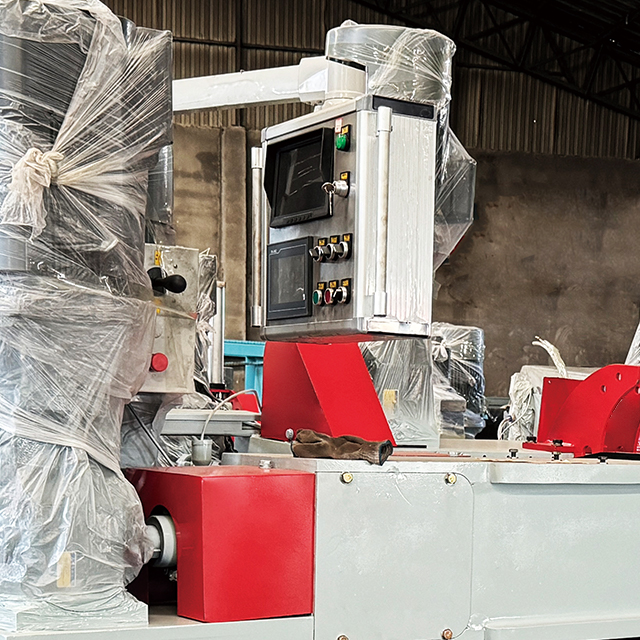
Perfect peeling requires flawless cutting geometry. The dynamic relationship between the cutting blade and the pressure bar dictates surface quality. The knife separates the wood fibers smoothly. The pressure bar compresses the block right before the cut. Balancing these two forces is essential for quality control.
Log diameters shrink rapidly during processing. The cutting angle must change to maintain optimal contact. A high-end Veneer Peeling Machine uses motorized, automated pitch control. It adjusts the knife angle dynamically during the peel. This prevents "chatter" marks on the sheet. Chatter causes deep ridges across the wood grain. Automated pitch control also prevents uneven thickness near the log core.
Controlling wood compression remains equally crucial. The pressure bar sits slightly ahead of the knife edge. It applies targeted physical force to the wood structure. This action prevents the fibers from splitting prematurely. It guarantees a highly uniform surface tolerance. Poorly calibrated bars cause deep checking and rough textures. Operators must monitor this delicate gap closely.
Common Mistakes: Many operators ignore pressure bar wear. They assume only the cutting knife requires regular replacement. Worn pressure rollers fail to compress fibers evenly. This oversight directly ruins micro-level tolerances regardless of CNC precision. Always inspect pressure bars during routine knife changes.
You cannot control something you do not measure. Advanced setups integrate sophisticated sensors directly into the production line. Laser thickness gauges scan the continuous wood ribbon. Ultrasonic sensors monitor density and structural integrity immediately post-peel. These sensors provide an unblinking eye on product quality.
These components form a highly responsive closed-loop feedback system. Lasers detect micrometer deviations as small as ±0.05mm. They instantly signal the PLC when readings drift. The PLC then micro-adjusts the servo feed instantaneously. It accomplishes this without stopping the production line. Active correction prevents scrap before it happens.
Modern control software automatically logs all this sensor data. Quality assurance teams use these records to track machine performance. Production managers identify patterns of blade wear early. They can spot structural vibration issues before they cause critical out-of-tolerance waste.
The following chart outlines the active feedback phases:
Operational Phase | System Component | Action Performed |
|---|---|---|
Detection | Laser Gauges | Scan thickness deviations in real-time. |
Analysis | PLC System | Processes data and identifies anomalies. |
Correction | Servo Drives | Execute micro-adjustments to the knife feed. |
Verification | Data Logger | Records drift patterns for QA review. |
Theoretical machine accuracy often clashes against harsh material realities. Raw timber introduces completely unpredictable variables into the process. Wood is naturally anisotropic. It behaves differently depending on the cutting direction. We must account for varying moisture content and frozen logs. These biological factors drastically change baseline peeling dynamics.
Dense knots generate massive physical shocks. Advanced lines counteract this blunt force mechanically. They employ heavy-duty hydraulic hold-downs. Vibration-dampening cast iron frames absorb the impact energy. Rigid frames keep the knife completely stable during difficult cuts. Lighter frames flex under pressure, ruining sheet accuracy.
Software presets simplify the operator's daily job. Modern Human-Machine Interfaces (HMIs) allow users to load specific material "recipes". These recipes optimize feed rates and pressure bar gaps automatically. You do not need to guess the correct settings.
Consider the following material challenges operators face:
Soft pine requires less physical pressure but higher rotational speeds.
Dense birch demands rigid mechanical dampening to prevent blade deflection.
Frozen winter logs need entirely different pitch angles to prevent shattering.
High-moisture logs swell, requiring dynamic gap adjustments throughout the shift.
Industry standards highly recommend sorting logs by species and moisture. Feeding a mixed batch confuses even the best CNC systems. Grouping similar logs allows the automated recipes to function perfectly.
Upgrading your line requires a strict technical evaluation framework. Buyers must first define their clear success criteria. Calculate your acceptable yield loss based on end-product value. Commodity plywood allows slightly larger tolerances. Architectural engineered flooring demands absolute micro-level precision.
Do not prioritize high-tech HMIs over basic hardware robustness. A beautiful touchscreen cannot fix a vibrating chassis. The underlying frame must possess enough tonnage to prevent deflection. Structural rigidity ultimately dictates long-term accuracy. Look closely at the casting quality of the main spindle housings.
You must also address organizational adoption risks. Highly automated systems introduce a steep learning curve. Operators must understand complex software diagnostics. They can no longer rely solely on mechanical wrenching. Prioritize comprehensive vendor training programs during negotiations. Untrained staff will bypass automated features, defeating the upgrade purpose entirely.
Finally, shortlist your equipment options through rigorous testing. Request pilot tests using your actual timber species. Demand fully documented tolerance reports from these trial runs. You need concrete proof before committing significant capital. Verify the availability of replacement sensors and servo parts locally.
Thickness control results from synergy between heavy mechanics, servo control, and real-time sensors.
Rigid cast iron frames remain essential for maintaining accuracy during knotty cuts.
Dynamic pitch adjustments actively prevent chatter as log diameters shrink.
Prioritizing vendor training helps bridge the automation learning curve for older operators.
Modernizing your peeling line transforms unpredictable waste into measurable profit. The technology exists to eliminate manual guesswork entirely. Contact a technical sales engineer today. Discuss specific ROI models comparing your current yield waste against a modernized CNC line.
A: The standard tolerance typically ranges from ±0.05mm to ±0.1mm. This specific range depends heavily on the wood species being processed. It also depends on the overall machine class. High-end equipment processing uniform softwoods routinely hits the tighter ±0.05mm margin. Denser hardwoods may push closer to ±0.1mm due to natural resistance.
A: As the log gets smaller, the cutting angle naturally changes relative to the center. Without dynamic CNC pitch adjustment, the knife begins to dig improperly. This causes the veneer to become thicker or rougher near the core. Automated systems adjust the blade pitch continuously to maintain a perfect angle regardless of diameter.
A: Yes, but only temporarily. Automated feed rates can make micro-adjustments to delay the negative impact of dull edges. However, physical blade wear ultimately requires manual replacement. Modern control software tracks deviation trends over time. It uses this data to signal maintenance intervals before the sheet quality drops below acceptable limits.
A: Wavy output usually points to a synchronization mismatch between feed speed and spindle speed. It can also indicate incorrect pressure bar alignment. Additionally, inadequate machine frame rigidity causes vibration during the cut. You should inspect the servo drives for faults. Verify the pressure bar gap is properly calibrated for the wood species.


