


Views: 0 Author: Site Editor Publish Time: 2026-08-12 Origin: Site


Operating a profitable plywood or veneer mill requires maximizing recovery rates from highly variable raw materials. You must extract maximum value from every single log. However, mills rarely process perfectly uniform logs. Shifts in log diameter heavily influence production flows. Varying densities between hardwood and softwood species add another layer of complexity. These shifts often lead to massive core waste, frequent machine recalibration, and unwanted operational downtime.
Upgrading to a modern Veneer Production Machine capable of dynamic adjustments solves these daily frustrations. It allows facilities to process a diverse raw material mix without sacrificing yield or throughput.
This guide breaks down the specific mechanical adaptations required for highly variable logs. We also provide a clear framework for evaluating equipment capabilities. You can apply these insights directly to optimize your own specific production line.
Modern veneer production machines utilize automated laser centering and variable spindle speeds to maintain consistent peeling as log diameter decreases.
Integrating a reliable wood debarker before the lathe is non-negotiable for handling diverse species, as bark thickness and grit levels vary drastically.
Spindle-less rotary lathes are critical for maximizing yield from small-diameter logs, turning former waste into usable veneer.
Evaluating machine procurement requires mapping your primary wood species’ density against the machine's torque capabilities and knife-angle flexibility.
The direct correlation between log diameter variability and profitability remains undeniable. Legacy machines often rely on fixed mechanical settings. Operators struggle when feeding shifting log profiles into inflexible equipment. Fixed-setting legacy machines produce much higher core drop-outs. They also generate uneven veneer thickness across different production batches.
Veneer mills lose money on every poorly peeled log. Suboptimal centering wastes the valuable outer sapwood. Improper pressure settings cause splitting. You simply cannot ignore the hidden costs tied to rigid equipment.
Consider the daily costs of inflexibility. Manual machine recalibration consumes valuable time when switching between different wood species. Your operators must stop the line to adjust knife gaps and pressure bars manually. This manual intervention causes severe operational downtime. You also face increased labor demands. The initial run waste spikes during the calibration phase until the machine stabilizes.
Defining success criteria helps you choose better equipment. A successful implementation relies on measurable production metrics. We evaluate new installations based on the following benchmarks:
Minimized minimum core diameter: Pushing the final drop-out core down to 30mm or 40mm.
Consistent thickness tolerance: Maintaining exact thickness across both dense and soft species.
Rapid species changeover: Utilizing software presets to adjust physical parameters instantly.
Reduced rounding waste: Maximizing continuous ribbon generation early in the peel.
Modern equipment eliminates human error during the loading phase. Advanced machines feature integrated 3D laser scanners. These scanners map the complete geometric profile of incoming logs. They capture data on taper, sweep, and surface irregularities in milliseconds.
The software calculates the true optimal rotational axis using this data. Traditional geometric centering simply finds the middle of the log ends. Laser scanning finds the maximum cylindrical volume hidden inside the log. The charger then positions the block perfectly onto the lathe spindles. This precision reduces initial rounding waste significantly. You get continuous veneer ribbons much faster, regardless of the starting log diameter.
Rotary peeling requires a constant peripheral cutting speed. The log shrinks in circumference as the peeling knife advances toward the core. If the rotational speed remains constant, the actual cutting speed drops rapidly. This speed drop causes uneven veneer thickness and rough surfaces.
Modern machines adjust RPMs dynamically to solve this geometric problem. Variable frequency drives accelerate the spindles continuously as the diameter decreases. They maintain a perfectly constant peripheral peeling speed. You achieve smooth veneer from the bark down to the core.
Handling extreme diameter changes requires multiple machine types. Mills typically orchestrate a sequence utilizing two distinct lathe designs:
Chuck-Driven Spindle Lathes: These machines handle large logs initially. Heavy hydraulic chucks grip the log ends firmly. They provide massive driving torque for large-diameter peeling. However, the chuck size limits how small the log can get. Once the knife approaches the chucks, the machine ejects the remaining core.
Spindle-Less Friction-Drive Systems: The remaining core moves to a spindle-less lathe. These systems ditch the end chucks entirely. They use powered peripheral friction rollers to spin the log. This setup is essential for peeling small-diameter logs. You can peel former waste cores down to an incredibly tight 30-40mm diameter.
Combining both technologies ensures maximum recovery. You extract valuable veneer from large logs while turning small drop-outs into usable material.
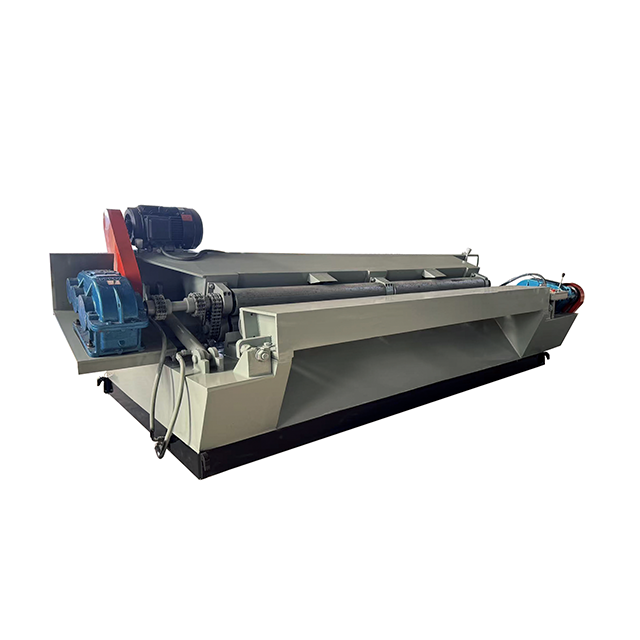
Different wood species behave drastically differently under the peeling knife. You cannot treat soft pine the same way you treat dense oak. Adjusting machine parameters based on wood density dictates your final product quality.
We face contrasting power requirements for different materials. Dense hardwoods require massive torque at the drive rollers. Species like birch and oak offer immense resistance against the blade. The motors must push through this resistance without stalling or chattering. High torque ensures steady rotation through dense knots.
Softer woods demand high-speed processing. Species like poplar and pine offer very little cutting resistance. You must peel them at much higher speeds to maintain efficiency. The equipment needs dynamic servo motors capable of delivering both high torque and high speed on demand.
Knife angle and pressure bar settings play a crucial role in managing species variability. You must execute micro-adjustments in the peeling knife pitch. Hard, brittle species require specific pitch angles to prevent structural splitting. The pressure bar must compress the wood fibers just ahead of the cutting edge. Proper compression prevents fuzzing and tearing in softer, spongy species.
Log pre-conditioning acts as a great equalizer. Boiling or steaming logs normalizes their internal density. This thermal treatment softens the lignin holding the wood fibers together. Pre-conditioning dramatically reduces the cutting force required. It impacts machine wear and tear directly. Your precision blades stay sharp much longer. Your drive motors experience less thermal stress.
Species Category | Typical Density | Primary Machine Requirement | Pressure Bar Setting | Pre-Conditioning Need |
|---|---|---|---|---|
Softwood (e.g., Pine, Poplar) | Low (350 - 500 kg/m³) | High peripheral peeling speed | Moderate compression | Low (Optional for some grades) |
Hardwood (e.g., Birch, Oak) | High (600 - 800+ kg/m³) | High drive torque | High compression | Critical (Boiling/Steaming) |
You cannot discuss cross-species peeling without addressing bark removal. Bark characteristics change completely depending on the tree species. Trying to process logs without proper preparation ruins valuable equipment.
Species-specific bark challenges demand versatile debarking solutions. Stringy bark from eucalyptus trees tangles easily around rotary shafts. It requires aggressive, toothed rotor profiles to shred the fibers effectively. Conversely, pine trees feature thick, brittle bark. Brittle bark snaps off in large plates. The debarking mechanism must crush and scrape these plates without damaging the underlying sapwood.
An industrial Wood Debarker serves as the primary defense mechanism for your production line. Logs arrive from the forest covered in debris. They carry embedded rocks, abrasive grit, and frozen ice. The debarker aggressively removes these hazards before they ever reach the peeling line.
Protecting the precision blades is paramount. The main lathe uses highly sensitive, perfectly honed knives. A single embedded rock can cause catastrophic chipping on the blade edge. A damaged blade produces scored veneer across the entire log. It forces an immediate line shutdown for blade replacement. Proper debarking eliminates this risk entirely.
Throughput alignment determines your overall factory efficiency. The debarker sits upstream of the main lathe. Its processing speed must match or exceed the lathe’s consumption rate. Handling high volumes of small-diameter logs puts immense pressure on the debarking station. The debarker must process hundreds of small logs per hour to keep the rapid spindle-less lathe fed. If the debarker slows down, the entire factory starves.
Evaluating new equipment requires a strategic approach. You must align the machine capabilities with your actual raw material supply. Buyers often overspend on unnecessary features or under-specify critical power requirements.
Assess your production volume versus your need for flexibility. Some facilities run a high-speed, single-species dedicated line. They process plantation pine exclusively. These mills benefit from highly specialized, rigid setups optimized for raw speed. They do not need complex changeover features.
Other facilities rely on a mixed supply chain. They might process pine on Monday and dense birch on Wednesday. These mills need a highly flexible, multi-species CNC lathe. A CNC lathe stores hundreds of material profiles in its computer. The operator simply selects the wood species on the touch screen. The machine automatically adjusts the knife gap, pitch angle, and roller pressure instantly.
Vendor validation remains a critical step in the procurement cycle. Never buy equipment based solely on a glossy brochure. You should request concrete proof of performance from the manufacturer.
Follow this shortlisting logic when engaging vendors:
Ship material samples: Send a representative batch of your typical logs to the vendor's testing facility.
Include worst-case scenarios: Include highly tapered logs, small diameters, and your most difficult wood species.
Require live test peels: Ask the vendor to process your specific log grades on their demonstration machine.
Analyze the output: Measure the thickness variance, surface smoothness, and final core diameter of the test batch.
This validation process protects your investment. It proves the equipment can handle your actual operational realities before you sign any contracts.
Processing a diverse mix of log diameters and wood species is no longer a factory bottleneck. The industry has moved past the limitations of rigid, legacy equipment. Facilities can achieve incredible yield if they invest in adaptive, CNC-driven veneer production technology. Coupling this technology with proper debarking pre-treatment guarantees a smooth operational flow.
Stakeholders should take immediate action to optimize their lines. We advise you to conduct a comprehensive raw material audit first. Document your average log taper, your absolute minimum diameter limits, and your typical species mix. Establish these hard baseline requirements clearly. Use this precise data when requesting technical specifications from manufacturers. A data-driven approach ensures you purchase the exact mechanical capabilities your mill actually needs.
A: Modern spindle-less lathes routinely push the core drop-out limit down to an industry standard of 30mm to 40mm. They use precisely controlled friction rollers to grip and spin the wood. This technology extracts maximum usable veneer from small-diameter logs, turning previously wasted cores into highly profitable material.
A: It depends on the blade metallurgy and bevel angles. Many mills use dual-bevel knives designed to handle both density spectrums reasonably well. You often rely on CNC software adjustments to change the knife pitch angle instead of physically swapping blades. However, extremely dense hardwoods might necessitate a dedicated, robust blade change.
A: Advanced debarkers utilize floating rotor capabilities and independent hydraulic pressure adjustments. The cutting teeth float along the natural contours of the log. The hydraulic systems adjust the pressure dynamically as the taper increases. This allows the machine to remove bark cleanly without gouging the valuable sapwood underneath.


